GPT-6 Astra: Where It Helps, What It Costs, and How to Use It Well
A practical, source-linked guide to GPT-6 Astra's long-context reasoning, computer use, coding, and professional workflows—with a cost-aware way to decide when it is actually the right model.
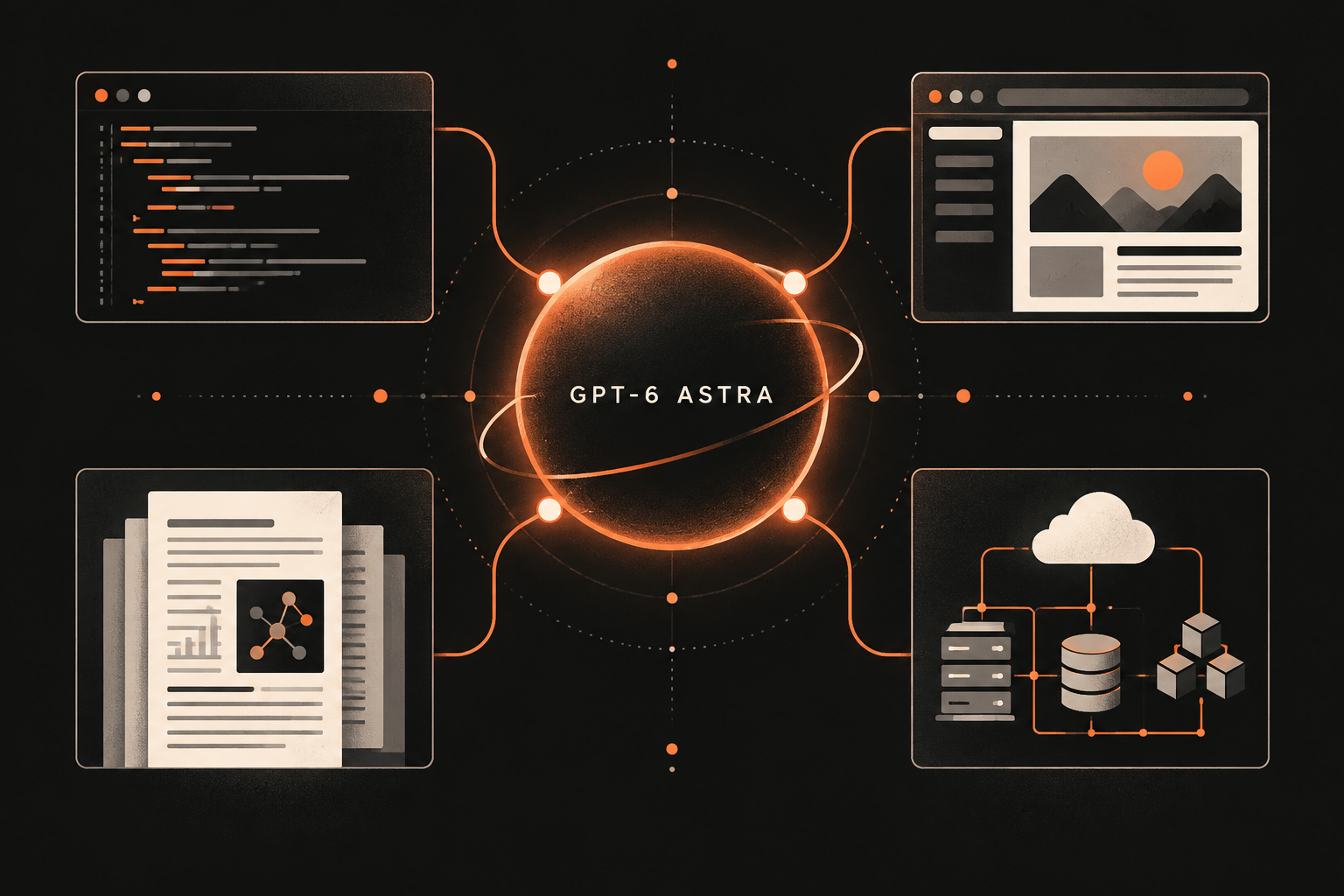
GPT-6 Astra is easy to describe badly. It is not simply “a bigger chatbot.” OpenAI positions it as a model for difficult end-to-end work: reasoning, coding, computer use, research, and document creation. The useful question for a team is more concrete: which jobs become cheaper, safer, or more complete when Astra is in the loop?
This is an original field guide, not a reproduction of OpenAI’s launch material. The model details and customer examples below are credited to OpenAI’s GPT-6 Astra announcement, the Astra API model page, and OpenAI’s business customer page. Check those sources before making a production decision because availability, pricing, and limits change.
The short version
Astra is most interesting when a request crosses several boundaries at once: it needs a plan, a browser or code tool, a long context window, and a polished artifact at the end.
It is a poor default for every request. A deterministic function, a small model, or a cached answer is still the better choice for simple, repetitive work. Astra’s standard API price is listed as $10 per million input tokens and $50 per million output tokens, with separate cache rates and tool charges. Its context window is 1.05 million tokens and its maximum output is 128,000 tokens. Those numbers make efficiency design part of the feature.
What changed in practice
OpenAI reports strong results on computer-use, coding, professional, long-context, science, and safety evaluations. Treat benchmarks as signals, not guarantees. The production difference is the model’s ability to carry a thread across steps: inspect evidence, choose a tool, recover from a failure, and hand back an artifact that fits a team’s template.
The API supports function calling, structured outputs, web and file search, code execution, computer use, MCP, hosted shell, and tool search. Astra also supports async tool calls, mid-turn steering, and changing reasoning effort while preserving the cached prompt prefix. That combination makes it a better fit for long-lived workflows than a single completion endpoint.
What early users say they are doing
OpenAI’s business page shares early customer reports. Epic Games describes using GPT-6 on C++ work at Unreal Engine scale and for multimodal support outside engineering. Perplexity reports pairing Astra with its Search as Code architecture for difficult research, with a reported 9% benchmark lift at 49% of the prior cost. These are customer statements, not independent audits, so use them as clues about workflow shape rather than promises.
The pattern is more reusable than the logos:
- Large codebases: ask the model to map a change, run tests, and explain the blast radius before editing.
- Research products: let the model gather, compare, cite, and structure evidence instead of returning an unverified paragraph.
- Document-heavy operations: provide a template, policy, and source files; ask for a draft plus a list of unresolved decisions.
- Computer-use workflows: use a browser or desktop only after defining permissions, confirmation points, and an audit trail.
- Science and data work: give it a sandbox, a reproducible dataset, and a requirement to show intermediate checks.
A decision rule for your own stack
Use the strongest model only when the expected value of completion exceeds the extra cost and risk. A simple routing rule looks like this:
- Code handles validation, lookups, arithmetic, and permissions.
- An efficient model handles routine classification, extraction, and grounded answers.
- Astra handles ambiguity, long context, difficult synthesis, recovery, and high-value deliverables.
Measure cost per successful task, not cost per token. Include retries, tool calls, human review, and the cost of a wrong answer. Astra can be cheaper at the task level when its stronger first pass prevents a chain of retries, but you have to measure that with your own traces.
A safe first pilot
Choose one workflow with a clear finish line, such as “turn a support escalation into a cited incident brief.” Freeze 30 representative cases. Record the current success rate, time to completion, human edits, tokens, tool calls, and spend. Then give Astra the smallest useful set of tools and a narrow permission envelope.
Require three artifacts from every run:
- the final answer or file
- a structured outcome record with citations and confidence
- a trace showing tools, retries, approvals, and unresolved questions
Review failures by slice. If Astra is better at the difficult cases but overkill for the easy ones, keep it as an escalation route rather than a universal default.
Governance is part of the model choice
OpenAI’s safety overview reports stronger robustness to jailbreaks and prompt injection than GPT-5.6 Sol, while also noting that Astra’s chain-of-thought monitorability is lower in adversarial tests. That is not a reason to avoid the model; it is a reason to avoid treating internal reasoning text as your only safety control.
Use allowlisted tools, least-privilege credentials, confirmation for irreversible actions, trajectory logging, output validation, and post-run evaluation. Make the model prove what it did through observable artifacts rather than asking reviewers to trust a hidden thought process.
The practical takeaway
GPT-6 Astra is best understood as a high-capability worker for messy, cross-tool jobs. Start with one measurable workflow, route selectively, preserve a human approval boundary, and compare total cost per successful outcome. The model is impressive. The operating system around it is what makes it useful.
Sources and further reading
Frequently asked questions
Should every request use GPT-6 Astra?
No. Use code or an efficient model for routine work and reserve Astra for ambiguous, long-context, cross-tool, or high-value tasks.
How should I evaluate Astra's cost?
Track cost per successful task, including retries, tool calls, review time, and failures—not just input and output token prices.
Can Astra safely operate a browser or desktop?
It supports computer use, but production systems still need least-privilege access, confirmations, allowlists, logging, and output validation.
Bhaulik Patel
Forward deployed AI engineer and creator of Deployed Engineer.